


Yellow Tailed Black Cockatoo Habitat Feeding Breeding Migration and Conservation Guide

Updated: Aug 1
Calyptorhynchus funereus Yellow Tailed Black Cockatoo in the wild - video by Brett
A Yellow-tailed Black-Cockatoo scientific name: Calyptorhynchus funereus can announce itself long before it comes into view. The call is a drawn-out, wailing contact note that carries across gullies, paddocks, coastal heath and suburban streets. Then the flock appears, slow-winged and deliberate, with flashes of yellow in the tail and a heavy bill built for hard cones, grubs and woody seed pods.
'Their song is mesmerising, and has the ability to connect within allowing an inner stillness to be experienced.' Isis
This guide looks at where Yellow-tailed Black-Cockatoos live, what native plants they feed on, how they move through the landscape, how they breed, and what helps them thrive in a changing Australian environment.

Meet the Yellow-tailed Black-Cockatoo
The Yellow-tailed Black-Cockatoo, now commonly placed in the genus Zanda, is one of Australia’s most recognisable large cockatoos. It occurs across much of south-eastern Australia, including parts of Queensland, New South Wales, the ACT, Victoria, Tasmania and South Australia.
It is a large, dark cockatoo with:
Black to sooty-brown plumage
Yellow panels in the tail
A yellow cheek patch
A broad, powerful bill
A slow, deep wingbeat in flight
Males usually have a dark bill and a duller cheek patch. Females often show a paler, horn-coloured bill and a brighter cheek patch. Young birds can be harder to separate, especially at a distance.

Despite the word “song”, Yellow-tailed Black-Cockatoos are better known for calls than musical song. Their voice is one of the easiest ways to identify them.
Listen to their call
Their classic call is often written as a long, mournful “kee-ow” or “wee-yoo”. Flocks use it to stay in touch while moving between feeding trees.
The call carries a long way, especially in still air. In forested valleys, it can sound closer than the birds really are.
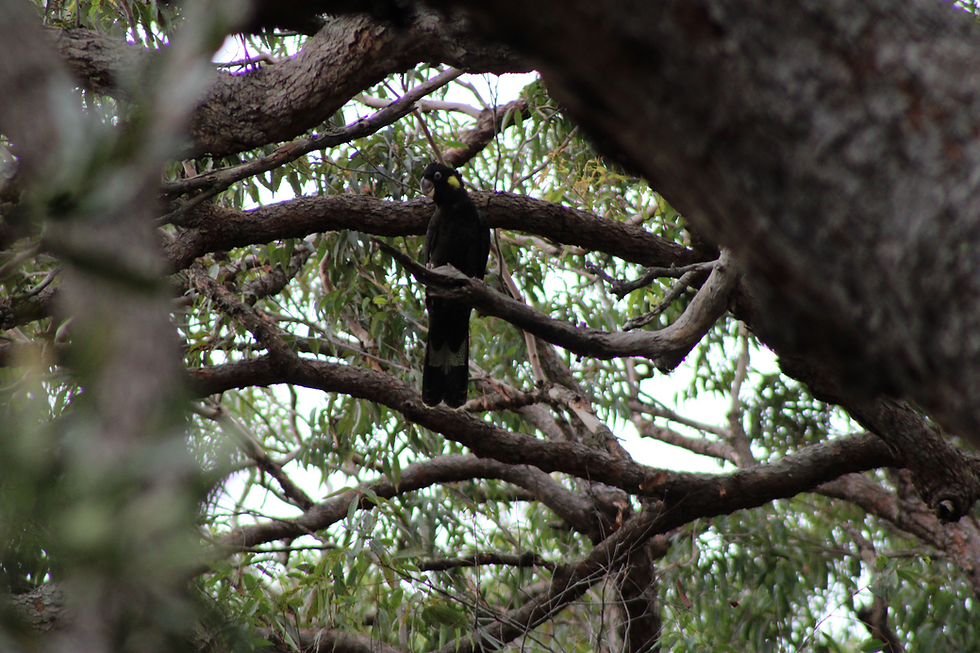
Yellow Tailed Black Cockatoo - Calyptorhynchus funereus - Photo by Isis
The habitats Yellow-tailed Black-Cockatoos depend on
Yellow-tailed Black-Cockatoos use a wide range of habitats, but they are not random wanderers. They follow food, water, roosting sites and nesting hollows. A useful habitat usually offers several of these needs within reach.
Wet forests and tall Eucalypt country
In wetter parts of south-eastern Australia, they use tall Eucalypt forests, gullies and forest edges. Mature trees matter here, especially old Eucalypts with large hollows. These forests also support insects in dead and dying timber, a key food source.
Birds may feed quietly among the canopy or tear into branches and trunks to reach beetle and moth larvae. Freshly stripped bark, gouged timber and piles of wood chips below a tree can reveal where cockatoos have been feeding.

Dry sclerophyll woodland and open forest
Dry woodland can be excellent habitat when it includes food plants such as Hakeas, Banksias, She-oaks, Wattles and Eucalypts. These areas often provide a mix of seeds and larvae, particularly after flowering and seed set.
Woodland with layers is more valuable than simplified paddock trees alone. A healthy patch may include canopy trees, shrubs, native grasses, fallen timber, dead branches and standing old trees.
Coastal heath and Banksia scrub
Coastal Heathlands and Banksia woodlands are important feeding areas in many regions. Banksia cones and Hakea fruits can hold food long after flowering, turning these plants into natural seed banks.
Cockatoos may return to the same patches when cones ripen. They often feed in a social, untidy way, dropping chewed cones and broken stems below shrubs.
Plantations, farms and suburban reserves
Yellow-tailed Black-Cockatoos also use modified landscapes. Pine plantations can attract flocks because pine cones provide rich seed. They may also visit gardens, golf courses, road reserves, shelterbelts and parks when these places contain suitable food trees.
That flexibility helps them, but it does not replace old native habitat. Plantations and suburbs rarely provide the deep, large hollows needed for breeding.

Native plants they feed on
Yellow-tailed Black-Cockatoos have a varied diet. They eat seeds, nuts, cones, fruits and insect larvae. Their bill lets them crush woody fruits and shred timber that many other birds cannot handle.
The exact diet changes with region and season. In one month, a flock may work through banksia cones. In another, it may focus on wattles filled with larvae or she-oak cones packed with seed.
Native food plant | What the cockatoos take | Habitat value |
Banksia species | Seeds from cones, sometimes larvae in wood | Important in heath, woodland and coastal scrub |
Hakea species | Seeds from tough woody fruits | Valuable in dry woodland and heath |
Allocasuarina and Casuarina species | Small seeds from cones | Useful in woodland, coastal edges and revegetation |
Acacia species | Seeds, pods and wood-boring larvae | Important for both food and insect prey |
Eucalyptus species | Seeds, flowers at times, and larvae in timber | Critical for feeding, roosting and nesting hollows |
Xanthorrhoea species | Flowering spikes and associated insects at times | Adds seasonal variety in heath and woodland |
Leptospermum and Melaleuca species | Seeds and insects in some areas | Useful in damp heath, creek lines and scrub |
Native conifers such as Callitris | Seeds where locally available | Can support feeding in drier regions |
They also feed on introduced pine seeds, especially in plantations. This food can be important, but it should not be confused with complete habitat. A pine crop may feed birds for part of the year while offering little nesting value.
They are skilled grub hunters
One of their most distinctive feeding habits is excavating wood-boring larvae. Cockatoos listen, inspect and then use the bill like a chisel. They strip bark and carve into branches or trunks to reach soft-bodied larvae hidden in wood.
This behaviour looks destructive, but it is part of the ecology of old and ageing trees. Dead limbs, fallen timber and standing dead trees support insects, which then support birds. Over-tidying bushland removes this food chain.
Daily habits and flock behaviour
Yellow-tailed Black-Cockatoos are social birds. They are often seen in pairs, family groups or small flocks, though larger feeding groups can form when food is abundant.
Their day often follows a loose pattern:
Leaving roost sites in the morning
Calling while moving across the landscape
Feeding for long periods in suitable trees or shrubs
Resting in tall trees during quiet parts of the day
Returning to safe roosts toward evening
They fly with slow, heavy wingbeats and often travel high above the canopy. Calls help the group stay together, especially when individuals are spread across feeding trees.
They are also messy feeders. Chewed cones, clipped branchlets, shredded bark and piles of debris below a tree are normal signs of feeding. In gardens, this can look dramatic, but it usually means the bird has found a strong food source.

Breeding and nesting
Breeding depends on old trees. Yellow-tailed Black-Cockatoos nest in large hollows, usually in mature or dead eucalypts. These hollows take a very long time to form, often longer than a human lifetime.
A good nest hollow is usually:
High above the ground
Deep enough to protect eggs and chicks
Wide enough for a large adult cockatoo
In a tree strong enough to remain standing
Close enough to feeding habitat for adults to raise young
Pairs are generally long-term partners. During breeding, the female spends much of her time in the nest hollow, while the male brings food. One egg is common, though more can occur. If two eggs are laid, often only one chick survives to fledging.
Breeding timing varies by region, weather and food supply. Across much of their range, nesting can occur from late winter through summer. In some areas it may extend outside that window.
Chicks develop slowly. They remain in the hollow for weeks before fledging, then continue to depend on adults while they learn to feed. Young birds may stay close to their parents for some time, calling with a begging note that is higher and rougher than the adult contact call.
Why hollows are a bottleneck
Food plants can be replanted within years, but nesting hollows are much harder to replace. Large hollows form after fire scars, broken limbs, fungal decay and long ageing. Removing old paddock trees, dead trees and hollow-bearing forest can remove breeding options for decades.
Artificial hollows can help in some targeted conservation programs, but they need expert design, safe placement and long-term checks. Poorly built nest boxes may overheat, fall, attract pests or fail to suit the bird.
Movement and migration
Yellow-tailed Black-Cockatoos are often described as nomadic or locally migratory rather than strongly migratory in the way some shorebirds are. They do not follow one simple, continent-wide migration route.
Their movements are shaped by food.
In some districts, flocks appear suddenly when banksias, hakeas, pines or she-oaks are seeding. They may stay for days or weeks, then move on. In other places, breeding pairs remain more local while non-breeding birds roam more widely.
Seasonal movement can include:
Shifting between coastal and inland feeding areas
Moving through valleys and ridgelines
Visiting pine plantations during cone availability
Using urban and peri-urban reserves when native food is scarce
Returning to traditional roosting or breeding areas
This is why habitat corridors matter. A single reserve may not meet every need, but linked patches allow cockatoos to move safely across the landscape.

Creating habitat for Yellow-tailed Black-Cockatoos
Good habitat creation starts with keeping what already works. Protect older trees, native shrubs and dead wood before planting new areas. A young planting can help future birds, but an old hollow-bearing eucalypt is irreplaceable on a short timescale.
Keep and protect mature trees
If it is safe to do so, retain:
Hollow-bearing eucalypts
Dead standing trees
Trees with large dead limbs
Isolated paddock trees
Creekline trees and shelterbelts
Where trees pose a safety risk near tracks, homes or roads, professional arborist work can sometimes reduce danger while keeping habitat features, check with your local council.
Plant a local food mix
Use locally native species where possible. Local provenance plants usually suit local soils, rainfall and insects better than plants from far away.
A strong planting mix may include:
Banksias suited to the district
Hakeas with woody seed capsules
Allocasuarinas or casuarinas
Wattles known to grow locally
Eucalypts that will become future canopy and hollow trees
Melaleucas or leptospermums for damp areas
Understorey shrubs that support insects
Plant in clusters rather than lonely rows. Cockatoos use big trees, but the whole food web benefits from layered vegetation.
Leave some mess
Neatness can reduce habitat. Fallen branches, leaf litter, bark, old logs and dead shrubs feed fungi and insects. Those insects feed cockatoos and many other birds.
A useful habitat patch does not need to look like a garden bed. It needs structure, food and time.

Conservation pressures and practical protection
Yellow-tailed Black-Cockatoos still appear in many places, which can make them seem secure. Yet local populations can decline when old habitat disappears piece by piece.
Key threats include:
Clearing of native forest, woodland and heath
Loss of hollow-bearing trees
Too-frequent fire that removes shrubs before they set seed
Long absence of fire in systems that need occasional renewal
Removal of dead wood and old trees
Weed invasion that changes understorey structure
Pesticide use that reduces insect prey
Vehicle strike when birds feed near roads
Climate stress affecting flowering, seeding and fire patterns
Conservation works best at several scales. A landholder can retain native trees and plant food species. A council can protect roadside vegetation and old paddock trees. A community group can restore creeklines. Land managers can plan fire in ways that protect seed sources and hollow trees.
For gardens and small blocks, the most useful steps are simple:
Plant locally native banksias, hakeas, wattles and she-oaks where suitable
Avoid cutting down mature native trees unless there is no safe alternative
Keep cats contained, especially near reserves
Avoid insecticides when natural pest control will do
Record sightings through local bird groups or citizen science platforms
Support protection of hollow-bearing trees in planning decisions
The Yellow-tailed Black-Cockatoo connected to all the elders of our ecosystems and is a bird of movement, memory and old trees. It can use suburbs, plantations and small reserves, but it still depends on native habitat with old growth. Protect the hollows, grow the food plants, keep the dead wood where it is safe, and leave room for flocks to move through the country. The reward is unmistakable: a wild, ringing call overhead and a flash of yellow through the trees.
Caring for Country, Together
"Nature thrives through connection, and so do we. We honour the First Nations Peoples whose enduring care for Country has sustained these landscapes for millennia. We recognise all who continue to protect, restore and learn from nature today, and we encourage future generations to become thoughtful caretakers of the living world. Every seed planted, every habitat restored and every act of stewardship helps shape a more resilient future for all life. May we each play our part in caring for Country, so that future generations inherit landscapes rich in life, diversity and possibility."
Happy creating with nature💚🌳💦

Comments